English
 العربية
 Español
 Pусский
Recent Posts
About us
-
We believe that: Good quality, competitive price and perfect after-sale service will make our products sell well in the world!We look forward to working with you in the near future!
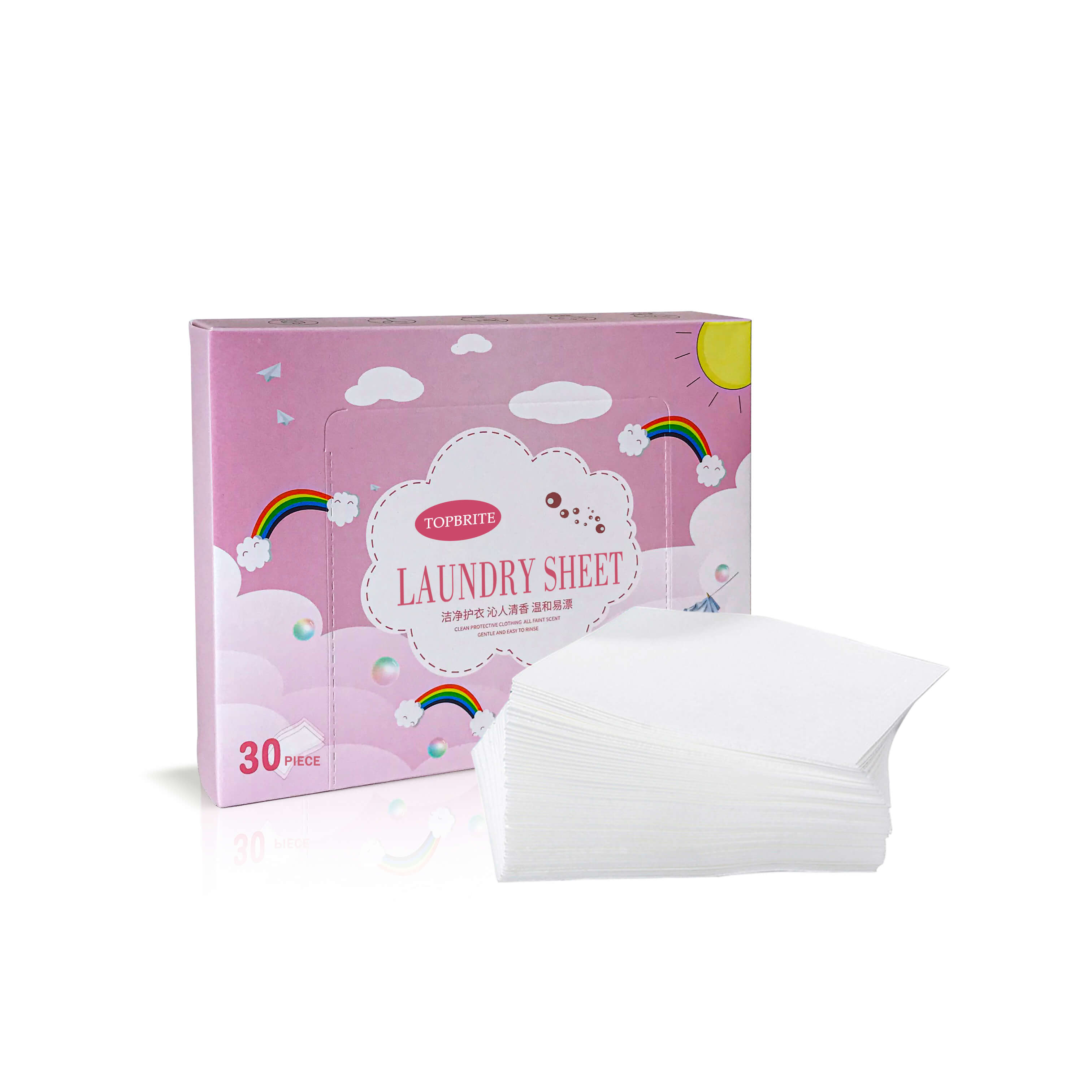
How to prove that laundry sheets are environmentally friendly?

To prove the "environmental friendliness" of laundry sheets, scientific evidence and authoritative certifications are required from multiple aspects, including raw materials, production processes, usage effects, and waste disposal. The specific methods are as follows:
I. Proof of Environmental Friendliness of Raw Materials and Ingredients
Compliance Testing of Ingredients
Entrust third-party testing institutions (such as SGS, Intertek, etc.) to test the ingredients of laundry sheets to prove that they contain no or low levels of substances harmful to the environment, such as:
No phosphorus, fluorescent brighteners, heavy metals (lead, mercury, etc.), volatile organic compounds (VOCs) and other substances restricted by regulations such as the EU REACH, US EPA standards, or China's Technical Requirements for Environmental Labeling Products;
Surfactants are biodegradable (e.g., meeting biodegradability test standards such as OECD 301B/C, proving that they can be decomposed by microorganisms in the natural environment without long-term residual pollution of water bodies).
Provide environmental protection qualifications of raw material suppliers, such as sustainable source certifications for plant-based raw materials (e.g., FSC certification for plant fiber-related raw materials).
Safety Statement of Ingredients
Issue a "Safety Data Sheet (SDS/MSDS)" detailing the impact of ingredients on the ecological environment (such as aquatic toxicity), proving that they are not significantly harmful to aquatic organisms, soil, etc.
II. Environmental Certification of Production Processes
Environmental Standard Certification for Production Links
Enterprises obtain international or domestic environmental management system certifications, such as:
ISO 14001 Environmental Management System Certification: Proving that the treatment of wastewater, waste gas, and solid waste in the production process meets environmental protection requirements, and energy consumption and pollutant emissions meet standards;
Cleaner Production Audit Certification: Evaluated by local environmental protection departments or third-party institutions, proving that the production process adopts environmentally friendly technologies with high resource utilization and low pollution emissions.
Proof of Energy and Resource Consumption
Provide data on energy and water consumption per unit product during production, and compare it with the industry average to prove that the production is more energy-saving and water-saving (e.g., through energy efficiency certification, water-saving certification, etc.).
III. Verification of Environmental Friendliness in Product Use and Waste Disposal
Testing of Environmental Impact During Use
The washing wastewater of laundry sheets is tested to meet local sewage discharge standards (e.g., China's Discharge Standard of Pollutants for Catering Industry (GB 18483-2001) is not directly applicable, but similar water pollutant limits can be referenced), ensuring that it will not pollute water bodies and soil;
If it is a concentrated laundry sheet, it is necessary to prove that it uses less dosage and reduces carbon emissions during transportation (which can be verified through carbon footprint certification, such as ISO 14067).
Environmental Friendliness of Packaging Materials
The packaging is made of degradable materials (such as PBAT/PLA composite film) or recycled materials, or has passed the "recyclable mark" certification, proving that packaging waste can be recycled or naturally degraded to reduce white pollution.
IV. Authoritative Environmental Certifications and Labels
Obtaining internationally or nationally recognized environmental certifications is a direct way to prove the environmental friendliness of laundry sheets. Common certifications include:
EU ECOCERT Certification: For natural, organic ingredients and environmentally friendly production processes, requiring products to meet environmental standards in terms of ingredients, production, and packaging;
US EPA Safer Choice Certification: Proving that products are safer for humans and the environment, with low toxicity and easy degradation of ingredients;
China Environmental Label (Ten-Ring Certification): Authorized by the Ministry of Ecology and Environment of China, covering the entire life cycle of products from raw materials, production, use to waste disposal;
Nordic Ecolabel (Swan Label): One of the strictest environmental certifications in Europe, with comprehensive requirements for the environmental impact of products.
V. Legal and Contractual Statements
Clearly mark environmental testing results and certification numbers on product manuals, packaging, or trade contracts, and promise to comply with environmental regulations of importing or exporting countries (such as the EU's EC 648/2004 Detergent Regulation). This constitutes a legally significant environmental statement, and legal liability shall be borne for false propaganda.
In summary, the environmental friendliness of laundry sheets needs to be proven through multiple dimensions such as "ingredient testing + production certification + evaluation of usage impact + authoritative labeling". Among them, third-party testing reports and internationally/nationally recognized environmental certifications are the most convincing evidence. In international trade, importing countries usually require these documents to confirm that the products meet local environmental protection requirements; otherwise, they may face customs clearance obstacles or market access restrictions.
Please contact Hebei Guangsheng Technology Co., Ltd. to learn more about the environmentally friendly laundry tablets products.We are committed to providing consumers with high-quality laundry products, solving laundry problems with innovative technology, and enhancing the quality of life with excellent service. Welcome to make a purchase and start an easy laundry journey!